“en”:”>>Narrator: Even though rehab can be a challenge, Robin Skinner is glad to be here. She had part of a lung removed because of cancer – which was discovered, purely by chance, during a routine exam. >>Robin Skinner: Cancer did run in the family, but I wasnu00d5t expecting it. I had no symptoms to know that I had cancer.rr>>Narrator: Thatu00d5s not uncommon. Many patients donu00d5t realize they have lung cancer until itu00d5s advanced. But the key to survival is finding it and removing it early. r>>Carlo Croce MD: The probability of cure, by removing the tumor from the lung of the patient, is very, very high. Otherwise, the probability of cure is very low.
r>>Narrator: Right now, the best way to find lung tumors is with a spiral C-T scan. But those are often prescribed only after there are signs of trouble. But the research of doctor Carlo Croce and his team at Ohio Stateu00d5s James Cancer Hospital could lead to a new approach – one that uses a simple blood test. They followed more than a thousand smokers and discovered that, in just a few drops of blood, they could detect signs of lung cancer in some patients a full 2 years before they were visible on a scan. But thatu00d5s not all they found. >>Carlo Croce MD: With this method we can determine that a tumor is developing, before a spiral CT, but we have also an indication of how bad that small tumor is.
>>Narrator: Knowing how aggressive a tumor might be, could soon allow doctors to be more aggressive with their treatments – all thanks to a simple… sample of blood. At Ohio Sateu00d5s James Cancer Hospital, this is Clark Powell reporting.. “
“en”:”The lymph is part of our bodies’ cleaning system and is also very important in fighting infection. Radiation and surgery, in particular the removal of lymph nodes, can create difficulties for this system, creating an effect known as lymphedema, which is swelling in the affected area. Luckily we’ve got some Jin Shin Jyutsu holds that you can utilize that will give you some help with this situation. For lymphedema in the left arm and chest, place the thumb of the right hand into the left armpit with the fingers gently clasped around the top of the arm. At the same time, the left hand is placed on the opposite inner thigh.
A second self-help hold for the left side is to place the right hand in the left armpit while the left hand makes an OK sign with the thumb lightly touching the left ring finger. These holds can be done for the right arm and chest by simply reversing the holds. These holds are very beneficial for post-mastectomy and post-lung surgery care. Lymphedema can also occur in the leg. To assist with swelling in the left leg due to this condition, place the left hand on the top of the leg in the groin area where the leg meets the torso.
At the same time, your right hand will cross the body to hold the left shoulder close to the neck. Make sure your arm is relaxed, lower it if you need to. You can reverse this hold for the opposite leg. Holding these placements for 20 minutes at a time is optimal, and do them as often as possible. You also might enjoy placing both hands on the top of the head two to three inches apart for 20 minutes for the entire lymph system, though this may not be comfortable for those who have had surgery in the chest area. Remember that the holds that feel the most comfortable to you are the ones that are going to give you the most benefit.. “
“en”:”- So occupational lung diseases are diseases of the lung that occur in response to some occupational or some work-related exposure. And at least in the developed world, the most common type of occupational lung disease is occupational, occupational, occupational asthma. So the most common type of occupational lung disease is occupational asthma. And you’ve probably heard of plain old regular asthma before but what distinguishes occupational asthma from regular old asthma is firstly, that occupational asthma is something that develops in adulthood. So it’s a type of adult onset asthma. And secondly, occupational asthma occurs in response to some trigger that’s found at work. So these patients will often experience signs and symptoms of asthma when they’re at work, when they’re exposed to this trigger at work. But when they come home, within a few hours of coming home, these symptoms will resolve on their own.
And on days that they don’t go into work, such as let’s say the weekend, they don’t experience these signs and symptoms of asthma. So here’s a lung, okay. And let’s say I was to take a cross-section of one of these airways like that and I was to look at that head on, so that this is my eye over here, what I would see would be something like this. I’d see the wall of the airway. This is the wall of the airway end. On the inside, this is the inner lining or– Actually, that’s not really good. So on the inside what I’d see is the inner lining of the airway. So that this hole in the center is a lumen through which the air actually travels, so this white arrow that I’m drawing is the air traveling through lumen of the airway.
So what happens in occupational asthma is in response to some work-related trigger, some work-related trigger, a couple of changes occur to this airway. So firstly what happens to the airway is that it becomes smaller. So you can see this airway is smaller than it normally is. And secondly, you see that– Secondly, you see that the lumen of the airway becomes smaller as well. And just looking at this very plain and simplistic diagram, you can see that trying to breathe through this airway is much more difficult than trying to breathe through a normal airway and this is what accounts for the symptoms of asthma. So I guess what’s left to explore is what are these work-related triggers that I’m talking about.
And actually, there have been greater than 350 described causes of occupational asthma. And at least in the United States, the most common cause, one of the most common causes is different types of flours. So that bakers are at an increased risk. And also different types of isocyanates. And isocyanates are these molecules that different industry workers, such as plumbers, such as plumbers and those who work with roofing and painters can often times become exposed to and also insulators can become exposed, too.
And something that is really important to keep in mind, is that even though there are 350 identified causes, not everyone exposed to one of these causes is going to develop occupational asthma. So occupational asthma, most common type of occupational lung disease. Now let’s move on to another type of occupational lung disease and that is– Let me get that squared away. And that is mesothelioma, so meso, meso, thelioma. Mesothelioma. And I’m sure you’ve heard of mesothelioma before, because it’s hard to watch even a day of TV without encountering one of those ads about mesothelioma. And how you or a loved one with mesothelioma are entitled to compensation. So what is mesothelioma? Well, first, let’s explore the linings of the lungs. So in pink over here, you see the visceral pleura. So this is the lining of the lung that’s directly adjacent to the lung, closest to the lung. And then what you see in orange over here, is the parietal pleura, the parietal pleura. So the parietal pleura is the lining of the lung, that’s adjacent to the chest wall, so further away from the lung. Now the pleura or the lining of the lung, is made up of cells called mesothelial, mesothelial cells.
And mesothelial cells have this really important function. They secrete this fluid that comes in between these two layers of the pleura and this fluid is really important because it reduces the friction between the two layers of the pleura. And mesothelioma is a cancer of mesothelial cells. And the reason why we consider it an occupational lung disease is because mesothelioma is related to asbestos exposure. It’s related to asbestos exposure. And asbestos exposure occurs with many types of occupations such as painters. Painters can be exposed to asbestos, as can shipyard workers. Shipyard, shipyard workers, and also those in plumbing. So plumbers can also become exposed to asbestos. And something, unfortunately, to keep in mind about mesothelioma is that, unfortunately, mesothelioma has a very high associated mortality, a very high associated mortality. And so those are two of the, two types of occupational lung diseases and now we’ll consider some other types.. “
“en”:”One of the important differences in lung cancers, to break it down into two categories: there’s what we call non-small cell lung cancer and there’s small cell lung cancer and for thirty or forty years we’ve divided them that way and the reason is because small cell lung cancer grows very fast, divides very fast and surgery, even for early disease, is generally not an option. It’s already spread by the time the surgeon takes it out or about the time the patient recovers. So, they stopped doing surgery on small cell lung cancer a long time ago. On the other hand, small cell lung cancer responds very well to chemotherapy It shrinks very quickly and we get dramatic responses. If someone just has a limited a small cell lung cancer we can cure them with the combination chemotherapy and radiation If they have extensive, meaning it’s spread somewhere else ( small cell lung cancer) we can’t cure it but we can significantly prolong their survival by treatment as well. Non-small cell lung cancer, which is the more common one with eighty percent of lung cancers, is approached for surgically and then with either radiation or chemotherapy or chemotherapy alone.
The other thing the past two or three years about non-small cell as we’ve been able to break it down even smaller groups. There’s the adenocarcinomas and the squamous cell carcinomas and the others and some of those have genetic mutations and there are drugs for specific mutations For some of these non-small cell lung cancers, oral drugs you take by mouth at home, very few side effects and work very well to control the disease so it’s important if you have a non small-cell for your tumor to be tested for genetic mutations to see if any of those drugs are applicable for you.”
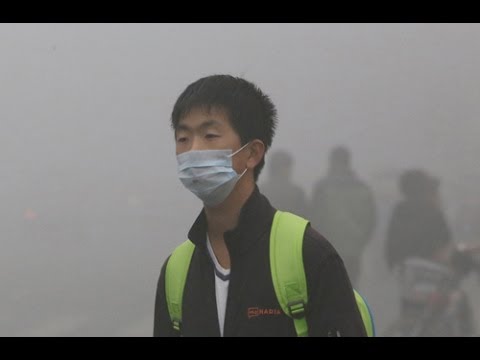
“en”:”A few weeks ago we did a story about super smog in China and how it causes cancer listen so they literally had to cancel school for a couple days because the smog like you know I grew up with snow days in the winters but they’re dealing with smog days airports were shut down certain highways were shut down that’s how bad it is you quite how can see because there’s so much pollution in the air so remember this story is breaking on the back earlier story that we cover last week which show that pollution was a meta-analysis from the World Health Organization over a thousand different studies that but proved that pollution air pollution is a carcinogen so northern Chinese is blended with with this carcinogen and a safe level of pollution under World Health Organization standards is 25 micrograms per cubic meter and in China it hit wanna thousand micrograms per cubic meter and the the machine that they use to measure this actually doesn’t go any higher than a thousand so it might even be that it’s way more than a thousand we know could be dole it could be two thousand we don’t know because the machine doesn’t go any higher in essence it’s gone to a point where in certain parts of China it’s become so bad that just going outside in breathing the air might be as bad as who smoking a cigarette all day long like 24 hours adjust inhaling as cigarette smoke well unfortunately all that is exactly right up from a report today quote doctors have diagnosed in eight-year-old girl with a long cancer and attributed to cause to air pollution the girl who remained on named as the youngest ever to be diagnosed with lung cancer in China their roles from the eastern China Chinese province 0 Jiang Xue which borders Shanghai and is home to the world’s leading exporters electronic equipment chemicals and textiles all the factories in the area make it one of the most polluted outside on northern China according to The New York Times a report on the girl quoted doctor fanning donji jiang’s to tumor hospital and non Jane with the girls being treated as saying that fine particulate matter known as p.m.
could lead to information wanted a cruise in the Longs and result in malignant changes Sony year old girl has lung cancer I because ive no environmental regulations and cancer-causing super smog in China is a tremendous problem and is a huge problem a at but see this this is why this pisses me off according to the International Agency for Research on Cancer quote in 2010 alone exposure to ambient fine particles was recently estimated to have contributed to million premature deaths predominately from cardiovascular disease and 223,000 deaths from lung cancer now look at those numbers million premature deaths because in the ambient fine particles in the air in other words the air pollution right million now imagine a million people but died from terrorism what would your reaction be paintball war for it we would declare war on anybody and everybody with this somewhat Middle Eastern sounding name or country now a the problem is that people in the United States but also people throughout the world we all suck at math so what do I mean well about thirty thousand people die every year from guns in the United States on average in nobody cares it’s not even an issue you know we can get a fuckin watered-down broke in background check bill through that was riddled with loopholes even that was too strong for r-ball politicians but people don’t even talk about that as much as they should thirty thousand gun deaths per year on average in the US a how many people die from terrorism less than a hundred people docking terrorism and everybody flips out about that all I got to be in the world so many died from terrorism but 30,000 people die from a guns net that’s nothing shut up about a job about it in fact I believe I have the official response hear from everybody now we don’t care I know the terrorism numbers much less but we’ll focus on that and more I how about the four thousand six hundred ninety people who were killed at work at work in 2010 alone in the United States as according to the Center for Public Integrity and that means that more americans died in the workplace in one year 2010 is about the same every year that number right then died throughout the entire Iraq war in 10 Americans died throughout the entire Iraq war well we we we lose it about that right about war but she nobody even talks about you know the unregulated work environment the US that leads to these deaths local we sup at math we suck at math so what should we do what we should put in owners and a focus on the things that actually matter so what are the actual problems in the world well the environment is getting destroyed its literally causing cancer now the smog is literally causing cancer solve the problems the world faces rampant industrial industrialization which leads to this I ramp in gun violence you know a non-regulated workplace now only in the US but of course another nations as well these are the real problems that people face and those are totally ignored and their the focuses instead put on bogeyman”
“en-US”:”Heartworms… Scary, huh? Like the semen collecting phantom. Or the chick shredder. You get the creeps even by hearing about them without knowing what they are about. Like in many cases, getting to know the facts may help. Just take this mosquito. It’s as stupid as a bag of rocks, it knows jack about heartworms even though it happens to be the vector of Dirofilaria immitis. The what of the what? The carrier of the heartworm. Intermediate host to be precise. And what now? For all the outward appearances, this is not the most efficient way of preventing heartworm infection. We may get a better idea by learning a little this and that about the disease. The worm will spend most of its life in the definitive host which is mostly the dog but for the sake of a brief adventure it will also make itself comfortable in the intermediate host, the mosquito.
So how does this happen? I’m sure we have all of us, at one time or another, swallowed something involuntarily. Say, a fly in the beer, a hair in the soup – yuck! – something like that. A friend of mine once swallowed a size 22 nut. He wasn’t entirely sober though. Much the same thing happens to the mosquito when it bites an infected dog. Along with the blood it will also suck in the microscopic larvae of the worm. The larvae, officially microfilaria but call them li’l worms, will spend about 2 weeks in the mosquito. While growing up, they dream about becoming nuclear physicists or astronauts. Well, don’t hold your breath on that. After the two weeks are over and the mosquito sucks blood again, it will – bleh! – puke up the worms.
Being puked up at the right time and at the right place is the key to success. Couldn’t be more true of little Dirofilaria. Should the mosquito miss biting a dog at the critical moment, the little worm’s career is doomed. Mehehe! Loser! In the lucky scenario, however – well, lucky for the worm, that is, dog and master will unlikely find any joy in it – the mosquito bites the dog and the larva sneaks under the skin through the duct of the bite and continues developing.
It wanders along in the body on a journey of spiritual self-discovery or whatnot, at any rate, because of its size it can’t do much harm to the dog at this point. In 2 to 3 months the violent bastard will break into a vein then drift into the lung artery through the heart. There, it will give up its childhood dreams and continue to live for the day sprinkled with hedonism and some Woodstock feeling. In case it has company – and mostly it does – we all know what happens. Six to nine months after it landed in the dog full of dreams and plans, it will give life to the first batch of kids, some one hundred thousand so child care allowance will amount to a tolerable sum. The li’l worms disperse in the blood where most of them simply perish after some time but the chosen ones will replay the big adventure of their ancestors inside the cosy shelter of a mosquito.
While splashing about in the pulmonary artery the adult female worm can grow to a length of 40 centimeters and as such, is an excellent measure of good parking distance from the kerb. The real pros, I have to add, take the male worms with their 15 centimeters for a standard. Either way, this length is enough for the worms to reach the heart and thus, earn their name. Otherwise, they’d just be called lung artery worms or Jack and Jill, which sounds less dramatic. Unless the dog dies first the developed worms might live as long as 5-7 years but as retired pensioners they don’t multiply in their last few years. They just play chess in the park. When their time comes they will find final rest in the vessels of the lungs. They are mourned by… Now that we are on close terms with the heartworm let’s have a look at the disease from the dog’s point of view.
What does it feel? Nothing for quite some time. But as the worms grow, filling the space in the pulmonary artery, the dog gets easily tired. It will cough and be short of breath. By the time the worms reach the heart the symptoms of severe heart failure will show until eventually… Should we panic? Depending on where you live on the globe heartworms may or may not be prevalent in your area. The parasite is more common in the warmer climate but it’s slowly spreading towards the colder regions. Its life cycle requires the presence of mosquitos, though, so if you live in Atlantis or in the Arctic you shouldn’t worry.
But even in the danger zones a coughing dog doesn’t necessarily mean a heartworm-infected dog. Just as people with high fever may not necessarily suffer from contagious encephalitis. But from now on who wouldn’t think of it immediately? At any rate, panic should be avoided but precaution is advised. It’s much easier to prevent heartworm disease than to treat it. What should be done? First of all, we must find out if our dog has heartworms. At midnight when there is a full moon a creature emerges from its cave in the Sumatran jungle: the worm-eyed Cyclops tells you the sure thing. 4, 8, 15, 16, 23, 42. Well, yes, he knows the winning lottery numbers as well but since contact is rather difficult to establish we have to rely on more practical methods which, unfortunately, are not a hundred percent reliable.
Diagnosis comes easy when the dog is choking and worms are breakdancing in its heart. X-ray and ultrasound imaging will leave us in no doubt. But heartworms are worth detecting when there are still no or hardly any symptoms since the chances of survival are much bigger then. There are several ways of finding out. There is an agent shed by the adult female worm that can be shown by a special test from a blood sample. The key words are adult and female. Males and young worms cannot be detected in this way. A simple yet rather sexist analogy would be that women have an aura of perfume fragrance while men stink and children don’t wear scent. Baby heartworms, when there are enough of them, can be spotted in the blood through a microscope.
This of course infers the presence of both adult males and females or how else would the little ones come about? Yeah, right… What if tests prove negative? Well, let’s open a bottle of champagne: our dog probably has no heart worms. Only you-know-who can say for sure apart from pathology, of course, but that’s a big jump ahead. First we’d better be happy about the good chance. And second: let’s get round to prevention! The vet will readily give you a preparation that will keep off intermediate host mosquitoes or kill off contagious larvae or both, making both dog and vet happy. Well, the stuff’s not that expensive. Most such products can be given monthly to provide a round-the-year protection. But we’re not out of the woods yet. Six months after the first test it’s worth while having another one to make sure the dog did not have a fresh infection previously which, as we know, the test would not have shown.
With the second test being negative the dog’s okay unless… Unless it has a male-only infection. But with no symptoms about this can only be detected with one method… From here on, the two things left to do are protecting the dog from the infection and having it tested once a year just to be on the safe side. What if tests prove positive? That kind of sucks.
Adult worms have to be killed which isn’t a joyride. Why, you ask? Because we’ll be replacing living worms with dead ones and although it may come as a surprise to some, dozens of 40 centimeter long dead worms in the heart are just as unhealthy as the same amount of living ones. The vet will perform months of pre-treatment to lessen the effect of complications and during the actual treatment the dog is placed under long of observation. At times like this everyone involved is little short of crapping themselves and a constant drumroll is heard in the background. Heartworm disease with severe symptoms is a special category and it’s really, really…
not good. Medication wouldn’t just kill off the worms but most likely the dog as well. But before we go into a rage vomiting boiling bile, mention must be made of another method namely dragging the worms out of the heart with the help of long forceps thrust in through the jugular vein. So, yeah… Of course, medication is still necessary as you can’t get rid of all the worms with the forceps. But removing most of the parasites makes each injection seem less like putting a nail in the coffin.
To sum up: Heartworm disease in dogs is spread by mosquitoes and can result in death. Prevention is easier than cure. Treatment is as fun as pricking hot iron under your nails. Dogs ought to be tested, it will provide important information for the master and income for the vet who can now buy that water filter for his pool he has always wanted. A cheap one. Everybody will come off well except for the heartworm. But there has to be a loser in every story. I whish good health to almost all animals. Er… I just have one question. What the f**k is a semen collecting phantom? The technical information presented in this video has been checked and verified by dr. u00c9va Fok – that’s F-O-K, okay? – PhD, veterinarian-parasitologist, member of the Department of Parasitology and Zoology of the Faculty of Veterinary Science in Szent Istvu00e1n University, Budapest, Hungary.
“en”:”- My brother died, he died of lung cancer and he was about the seventh or eighth member of my family to die of lung cancer and I had asked my doctor to schedule a chest X-ray for me because I was scared. She told me that if you can see lung cancer on a chest X-ray, you’ve got bigger problems. So she said, “What you need is a CT scan” and CT scans are very expensive, I had no symptoms, which is one of the problems with lung cancer, it doesn’t pop up until it’s in later stages.
I said I wasn’t going to spend that kind of money, $3,000 or whatever on a big if, you know, there might not be anything wrong. Little did I know, I had a cancerous tumor in my chest as I was talking with her, but it was at an extremely early stage. She said, “Well, I just heard about a brand new program “offered by Middlesex Hospital and you want to do this” and at the time, it was a $250 CT scan and I said, “Sign me up” and five days after I had the CT scan, I got a phone call saying I have lung cancer. Four or five weeks later, I spent two days in the hospital, and that’s it. No chemo, no radiation, they saved my life because I wouldn’t have had any way of knowing that the cancer was in my chest until later, had it not been for that program, period, end of story, they saved my life. The idea of instituting a low dose CT scan program was just off the charts smart.
When you’re the first time to do something, the word innovator applies and that innovation, flat out, saved my life. So, to say I’m a champion of the hospital would be a classic understatement.. “